GRDF × Arena Media × Cutz × Precious
CO2 emissions saved during the campaign
223T
File size reduction
89%
Three independent industry awards for the same campaign, a rare convergence of creative and environmental recognition.
Gold
Responsible Advertising
Nuit des Rois 2025
Gold
Energy Transition
Deauville Green Awards
Silver
Energy Transition
Deauville Green Awards
How GRDF saved
223 tonnes of CO2
on the Green Gas campaign

A national eco-friendly campaign that won a Gold award at the 2025 Nuit des Rois and a Gold and a Silver at the Deauville Green Awards. GRDF, in partnership with Arena Media (Havas Media Network), Rosa Paris, Cutz, and Precious, ensured that its message and approach remained consistent right down to the very last byte transmitted.
TV coverage
69.5% coverage
4.6 frequency
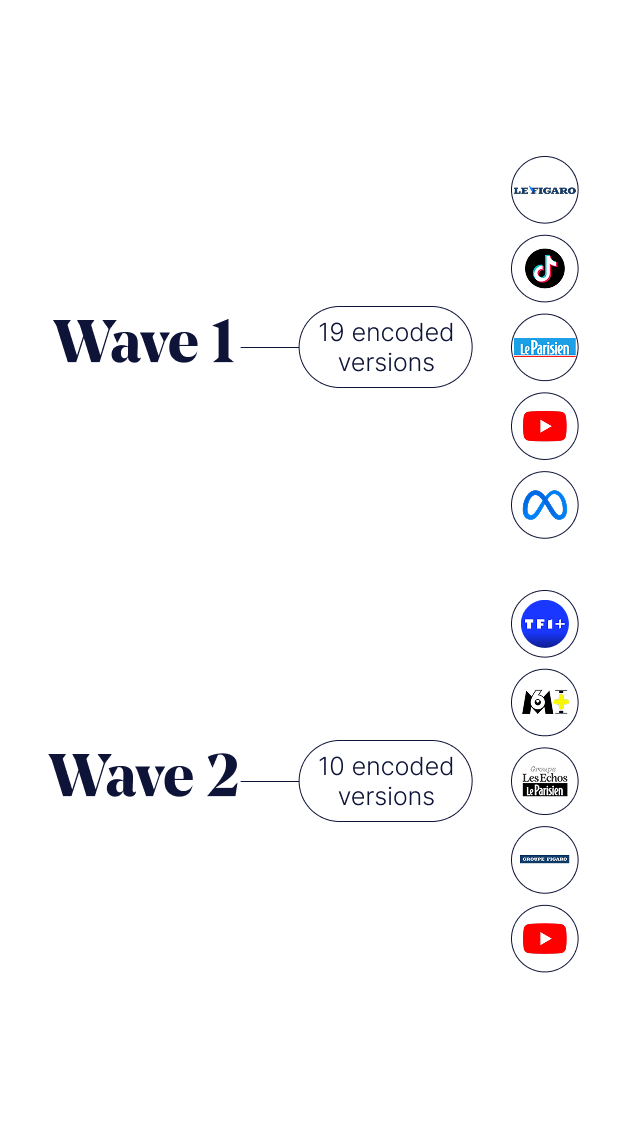
Wave 1: 21 February to 6 March 2025
Wave 2: 4 to 17 May 2025
Precious
Production
Reducing the carbon footprint of film production (shooting, post-production)
Cutz
Broadcast
Low-carbon video encoding, reducing the file size of content streamed on digital platforms
- ADEME Calculators · Empreinte Database for emission factors related to video streaming.
- AFNOR standards for general methodological guidance.
- ARCEP Reports on Sector-Specific Data Regarding the Digital Footprint.
- Final approval: the Havas Carbon Impact program, integrated into the media agency’s tools.
Context
In April 2024, GRDF is launching a large-scale campaign for Green Gas, featuring Jamel Debbouze and created by Rosa Paris.
The goal: to raise awareness of a renewable energy source produced locally from organic waste, and to establish Green Gas as a pillar of France’s decarbonization efforts alongside green electricity.
But GRDF goes beyond the message. The company has chosen to measure and reduce the carbon footprint of its own campaign, in line with its brand positioning and its Just Decarb program.
The question becomes a practical one: How can we align the substance (clean energy) with the form (responsible media outreach)?
Challenge
A 360° campaign featuring a well-known brand ambassador involves a significant amount of media coverage: TV spots, out-of-home advertising, digital, and social media, rolled out in several waves over 18 months. Every channel, every platform, and every format generates its own carbon footprint, one that is often invisible in the final tally and rarely measured at the time of production.
Arena Media (Havas Media Network), GRDF’s media agency, has chosen to include a clear requirement in the brief from the outset: to reduce the campaign’s carbon footprint without compromising its reach, visual quality, or effectiveness. It is in this context that Cutz has been brought on board as a specialist in low-carbon video encoding.
The Arena Media method in three pillars
Arena Media structures its media strategy around three principles, all of which are verified by the Havas Carbon Impact framework.
- Presence – at the right time, in the right place, with the right audience
Rather than casting a wide net, the approach prioritizes precise targeting. One in two people consumes multiple media sources at the same time: capturing their attention requires appearing in the right contexts, not simply taking up space.
- Affinity contexts
Editorial targeting consistent with the campaign’s theme: nature, wellness, and the environment. The ad placements are integrated into a continuum of content relevant to an audience aware of the energy transition.
- “Green Enthusiastic” optimization
Targeting a specific affinity segment – audiences committed to environmental causes – identified using Havas Media Network’s planning tools. The message resonates more deeply because it is directed at those who are receptive to it.
Cutz's role: lighter encoding, better streaming
Cutz specializes in low-carbon video encoding. One of the most significant – and, paradoxically, least measured – sources of carbon emissions in a video campaign is not production, but distribution. Every view consumes bandwidth; every large file consumes twice as much bandwidth as an optimized file.
Cutz’s encoding technology is based on artificial intelligence. The files delivered are smaller without compromising perceived visual quality. With each impression, the impact is reduced; when multiplied by the campaign’s volume, the savings become significant.
A 360° approach, Cutz and Precious
Cutz is part of a broader initiative. The campaign also involves Precious, which focuses on the upstream aspects: the film’s eco-friendly production (filming, post-production, logistics).
Measurement methodology
The 223 metric tons of CO2 saved are not just a claimed figure. They are based on a calculation methodology developed by Cutz using recognized public standards and subsequently validated by the Havas Carbon Impact program.
The scope covers the distribution phase (file size × number of prints × ADEME emission factors). The reduction is calculated by comparing the original (unoptimized) file with the file encoded by Cutz, at equivalent perceived quality.
The results
The Nuit des Rois jury, composed primarily of media buying executives from leading advertisers, praised the quality of the submission. Gabriela Grajewska, a member of the 2025 jury, noted in particular that “the concept of impact is becoming the guiding principle of all campaigns,” citing the reduction in file sizes as a concrete example.
Indicator
File size reduction
Total CO2 avoided
Perceived visual quality
Reach / coverage
Result
89%
223 tonnes
Preserved
Preserved
Equivalent
Between the original version and the Cutz version
≈ 223 Round-trip flights Paris–Las Vegas
No degradation identified by Arena Media or GRDF
69.5% coverage, 4.6 frequency
What this case demonstrates
Measuring and reducing the carbon footprint of a video campaign is not a technical nicety reserved for niche brands. It is an achievable goal within the context of a mainstream campaign, featuring a well-known talent, massive TV coverage, and without compromising on creative quality.
The initiative led by GRDF and Arena Media – in collaboration with Cutz and Precious – demonstrates that aligning message and method is possible today. The joint recognition from the Nuit des Rois and the Deauville Green Awards serves as public validation of this effort.
“At GRDF, we are convinced that our commitment to decarbonization must be carried out at every level and must also be reflected in the way we communicate. That’s why, together with Arena Media, we sought a partner capable of tangibly reducing the carbon footprint of our advertising assets – particularly video – without sacrificing reach or quality. Cutz has enabled us to achieve this goal, with measurable and certified results.”
Alexandre Hassani – Head of Brand and Social Media, GRDF
Reduce the weight of your videos, not their quality.
Cutz is the AI video encoding technology that makes your files lighter with no compromise on visual quality. Broadcast lighter, stream faster, and weigh less on your infrastructure and on the planet.
Test Cutz on your next productions.