Your videos, uncompromised.
Your delivery, lighter.
Your costs, reduced.
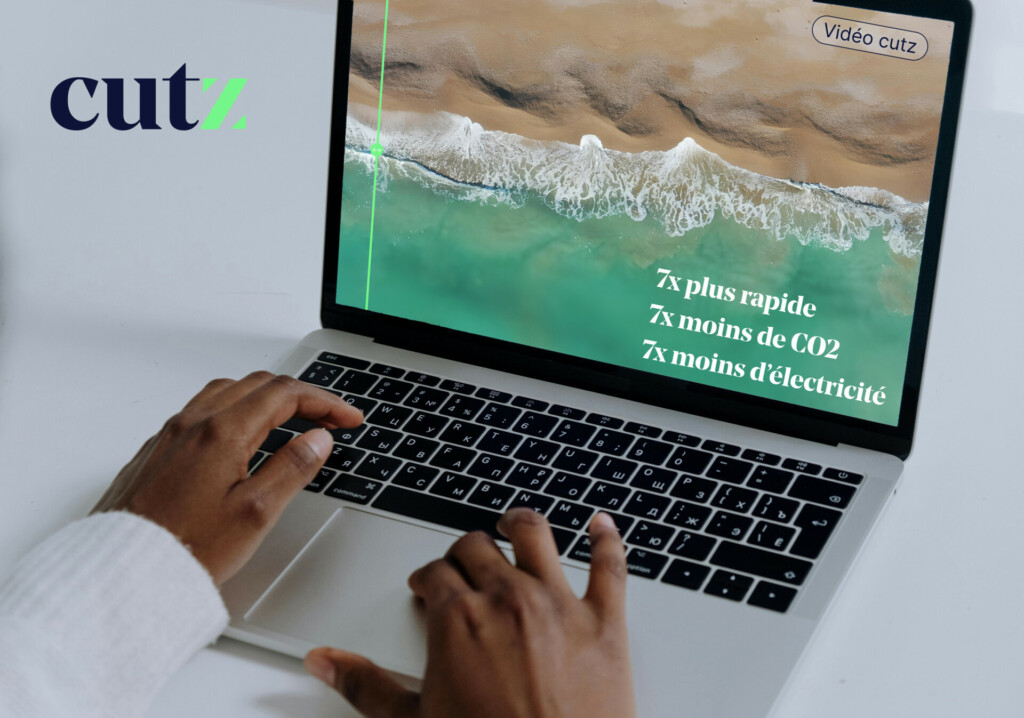
Cutz encodes your videos using AI Machine Learning: uncompromised visual quality, lighter files, leaner delivery.
Your audiences get a seamless experience. Your teams gain in productivity. Your infrastructure costs less. If your CSRD reporting, your clients, or your management require an impact estimate, the data is there.
Free trial – 10 videos or 30 minutes of encoding, no commitment.

Uncompromised. Every pixel. Every screen.
Your brand deserves videos that do it justice. Cutz makes no compromise on quality.
Cutz encoding is driven by perceptual Machine Learning: bits are allocated only where the human eye perceives them.
The result: VMAF above 95 measured in production across all our deployments. No visible artefacts, no degradation on mobile, desktop, TV, or DOOH. Every video encoded with Cutz is a video that reflects exactly the quality your brand demands, regardless of device, regardless of channel.
VMAF >95 in post-production
The industry’s most precise perceptual quality metric. Verifiable on your own content from the free trial.
No compromise regardless of device
Mobile, desktop, TV, DOOH, the same uncompromised quality on every screen, every resolution.
Your brand commits. Without compromising on quality.
A film encoded with Cutz is a film that honours the original creative intent. No visible degradation, ever.
Lighter videos. Smoother experience. Higher engagement.
Perfect quality and lightness: the guarantee of a frictionless user experience. A lighter file loads faster.
A video that loads fast is an audience that doesn’t drop off before it starts. And a visually flawless video is an audience that stays until the end. The mechanics are straightforward: Lighter file → faster loading → lower pre-play drop-off → higher completion rate → increased engagement → better content ROI.
“A large-account mobile campaign”: 55 videos encoded with Cutz, VMAF 96, loading 10 times faster under 4G conditions. Result validated under real mobile delivery conditions.

Less data. Lower bill. Same quality.
Reducing your video files also means reducing your CDN bill. Immediately. For organisations managing high volumes of video – training, internal communications, product catalogues, marketing campaigns, social media – storage and delivery infrastructure represents a growing and often underestimated cost.
Cutz encoding reduces your file size with no visible loss in quality. Every byte saved translates directly into savings on your cloud storage, server, and CDN bandwidth bills.
Secure your video library at a controlled cost. A lighter video catalogue is a sustainable catalogue, accessible, and less exposed to cloud cost inflation.

SaaS or API. Up and running in under an hour.
Your teams don’t need to become video encoding experts.
The Cutz SaaS platform is also built for marketing, communications, and HR teams, not just video engineers. Drag-and-drop interface, channel presets, weight reduction data generated automatically. Your teams are up and running in under an hour. For IT departments and technical teams managing high-volume video workflows: a codec-agnostic API (compatible with H.264, HEVC, and others) integrates directly into your existing architecture with no pipeline redesign.
SaaS Mode
For marketing and communications teams · Collaborative web interface · Drag & Drop · Channel presets · Shared video library · CO₂ data included
API Mode
For IT departments and system integrators · Codec-agnostic · Deployed in hours · Compatible with existing architectures · Scalable
Less data. Less energy. Better balance sheet.
CSRD doesn’t make exceptions for corporate video.
Your videos are delivered continuously, internal communications, marketing campaigns, training, social media. Across servers, CDNs, and screens of every kind. That delivery consumes energy and emits CO₂. Since 2025, the CSRD requires large companies to include this digital impact in their sustainability reporting, held to the same standard as financial reporting. The REEN framework and BEGES point in the same direction. Without reliable data on your videos, this footprint remains a blind spot in your GHG balance sheet. The most direct way to act: reduce file size at encoding. Less data to deliver means mechanically less energy across the entire chain.
Before/after encoding weight reduction is a direct, factual figure. Optionally, a CO₂ estimate can be produced from that reduction and your distribution volumes, using Scope 3 reference frameworks. This data provides a precise picture of impact, it does not replace a carbon audit, but it allows you to feed a CSRD report or respond to an RFP.

Real-world results, not estimates
Santeclair, −87% carbon footprint
Corporate video catalogue optimised. Direct savings on delivery infrastructure costs.

GRDF, 223 tonnes of CO₂ avoided
−89% carbon footprint reduction across the corporate video catalogue. Documented report integrated into the annual CSR balance sheet. Gold Nuit des Rois 2025 — Best Digital CSR Initiative







Frequently asked questions
Does the CSRD actually require us to report the footprint of our videos?
Yes. The CSRD mandates sustainability reporting that includes a company’s digital footprint, held to the same standard as financial reporting. The REEN (French law) and the extended BEGES point in the same direction. Video delivery and storage fall under Scope 3 of your GHG balance sheet — they must be measured, documented, and reduced where possible. Without a dedicated solution, this data cannot be produced in a documentable way.
On what basis is CO₂ data produced? Can it be used by CSR auditors?
Cutz provides two levels of data. Before/after encoding weight reduction is a factual figure produced directly by the encoder. Additionally, a CO₂ model is available, built from that weight reduction and your distribution data, using Scope 3 reference frameworks — the same benchmarks used by CSR audit firms to validate GHG inventories. This data can be integrated into a CSRD submission or an RFP response.
Does Cutz integrate into our existing IT infrastructure, or does everything need to be reconfigured?
No reconfiguration needed. Cutz is built for full interoperability: compatible with H.264, HEVC, and other standard codecs. Two integration modes available — SaaS (web interface, zero installation) or API (deployed within hours into your existing pipelines). Our engineers support you through the first deployment. Our corporate clients describe go-live as “much simpler than expected”.
What concrete savings can we expect on infrastructure costs?
Savings depend on your video volume, your current CDN infrastructure, and your storage providers. What we can say with confidence: every reduction in video file size and bitrate translates directly into savings on your bandwidth and storage bills. The free trial (10 videos or 30 minutes of encoding) delivers a quantified business case based on your own catalogue — before any commitment.
How do we ensure the confidentiality of our internal content?
Cutz is fully GDPR-compliant. Your content remains your content: it is never used for algorithmic training or third-party benchmarking. For organisations with specific contractual requirements — financial services, healthcare, defence — we put in place dedicated data processing agreements and can discuss sovereign hosting solutions.
Test Cutz on your videos